


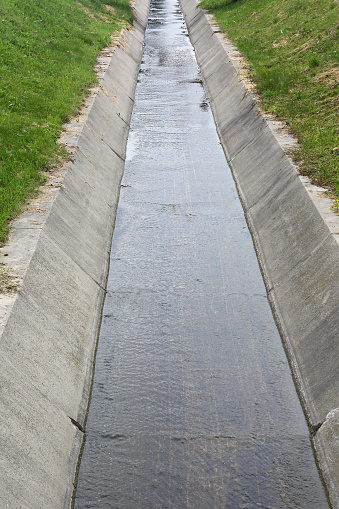
Canal linings are continuously exposed to flowing water, temperature variation, drying shrinkage, ground movement, wet-and-dry cycles, abrasion, and changing environmental conditions. Over time, small cracks and surface deterioration can create pathways for water seepage, vegetation growth, weaken the lining, and increase maintenance requirements.
Concrete canal linings depend heavily on crack control and surface integrity.
Small shrinkage cracks can gradually widen due to temperature changes, water movement, settlement, repeated wetting and drying, and environmental exposure. These cracks may allow water to penetrate through the lining, increasing seepage and contributing to progressive deterioration.
Canal Linings?
Glassman AR Glass Fibres by DD Solutions help improve concrete canal linings by reinforcing the concrete matrix from within. The fibres help control early shrinkage and micro-cracking, reduce permeability, improve surface integrity, and support long-term durability.
For irrigation canals and water-conveyance structures, Glassman provides a practical, non-corrosive micro-reinforcement solution that helps maintain a more consistent and durable concrete lining.
Glassman AR Glass Fibres disperse throughout the concrete matrix and help control micro-crack formation during the early stages of curing. By improving internal crack control and limiting interconnected micro-crack pathways, the fibres can support a denser and more durable canal lining.
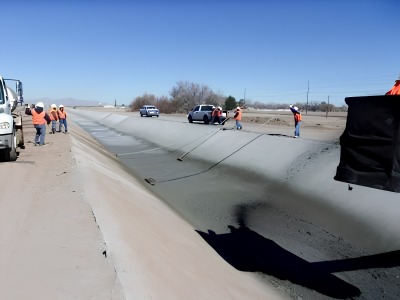
Key Benefits
Typical Applications
- Concrete drainage channels
- Water-conveyance channels
- Canal rehabilitation and repair works
- Canal lining overlays
- Precast canal lining elements
- Irrigation canal linings
- Main canals
- Branch canals
- Distributaries and minor canals
- Agricultural water channels
Usage & Mixing Guildlines
- Add Glassman fibres during the final stage of concrete mixing
- Introduce fibres at the batching plant, transit mixer, or site mixer
- Mix thoroughly until fibres are uniformly dispersed
- Maintain suitable workability for placing, compacting, and finishing
- Conduct trial mixes for project-specific concrete grades and lining thicknesses
- Ensure proper placement, compaction, joint construction, and curing
Quality Standards
Glassman AR Glass Fibres fall within the technical category of alkali-resistant glass fibres used in fibre-reinforced concrete and cement-based applications.
ASTM C1116/C1116M recognizes concrete containing alkali-resistant glass fibres within the classification of glass fibre-reinforced concrete.
ASTM C1666/C1666M covers alkali-resistant glass fibre used in Glass Fibre Reinforced Concrete (GFRC), fibre-reinforced concrete, and other cement-based applications.
Recommended Fibre Types
Glassman AR Glass Fibre – 6mm to 24mm
A wide range of fibre sizes can be used for concrete canal linings, water channels, repair overlays, drainage channels, and surface crack-control applications, based on engineering requirements and project needs.
Suggested Dosage
Concrete Canal Lining Applications
Final dosage should depend on:
• Lining thickness • Concrete grade • Water exposure conditions • Surface finish requirements • Hydraulic and environmental exposure • Project specifications • Trial mix results
0.5 kg to 1.0 kg per m³ of concrete
Technical Note
Recommended dosage and fibre length should always be finalized based on the application, mix design, site conditions, and trial results.
For structural replacement of steel reinforcement, project-specific validation by a qualified engineer is required.